I always hear that laser eye surgery is getting better every year, but is that true?
When my brother began looking into laser eye surgery for himself, I began to investigate and here is what I found.
What already improved
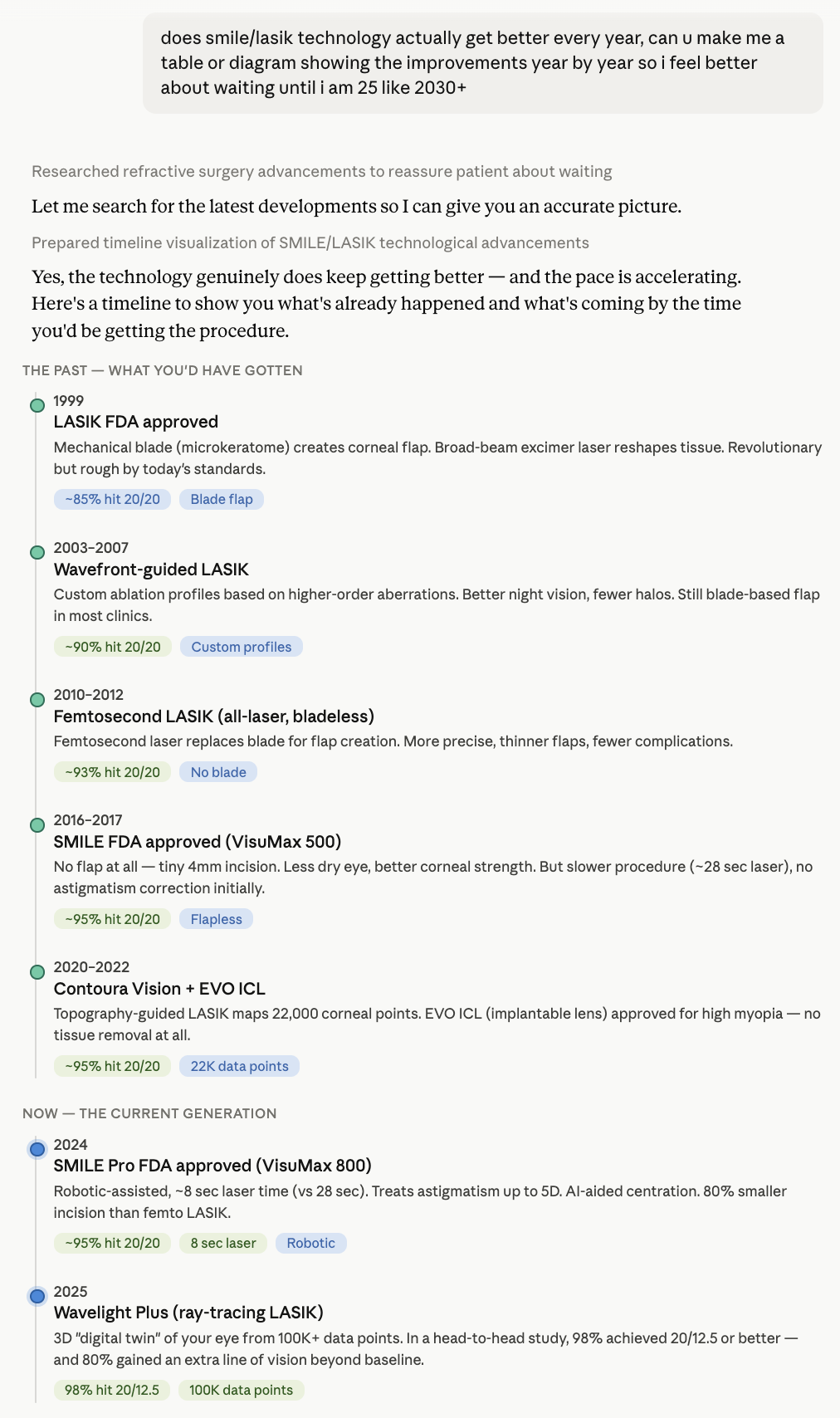
- 1988 First laser reshaping of a living human eye (PRK)
- 1989 to 1990, then 1999 LASIK: patented, first performed, then FDA-approved The flap technique was patented by Peyman in 1989 and first done on human eyes by Pallikaris around 1990. The flap is cut with a blade at first. FDA approval in 1999 is when it went mainstream, with much faster recovery than PRK.
- 2001 Bladeless "femtosecond" flap cutting A laser cuts the flap instead of a blade, so the flap is thinner and more predictable.
- 2002 Wavefront-guided custom treatments The laser corrects a detailed map of your eye instead of just your glasses prescription. Better night vision, fewer halos.
- 2016 SMILE FDA-approved
- 2022 EVO ICL implantable lens
- 2024 SMILE Pro The updated SMILE laser cuts the disc in about a third of the time.
A 2016 review of 97 studies (almost 68,000 eyes) found 99.5% of patients ended up 20/40 or better (good enough to drive without glasses) and only about 1% were dissatisfied.1
Downsides
- LASIK: the flap never fully heals. A cadaver study measured the healed flap at about 2% of normal corneal strength, and there are rare case reports of flaps knocked loose by trauma to the eye decades later.2 Debris and cells can also get under the flap and cause inflammation, mostly around the time of surgery.3 Try really hard not to get pepper sprayed. Fine particles can get lodged under the flap and inflame it, which is why some police and military eye-care guidance nudges people toward the flapless procedures.4 Don't ask me how I know.
- SMILE: less dry eye in the first months than LASIK, and the cornea may stay sturdier (studies in real eyes are mixed). Not approved for farsightedness in the US yet, and touch-ups are trickier.5
What's still coming
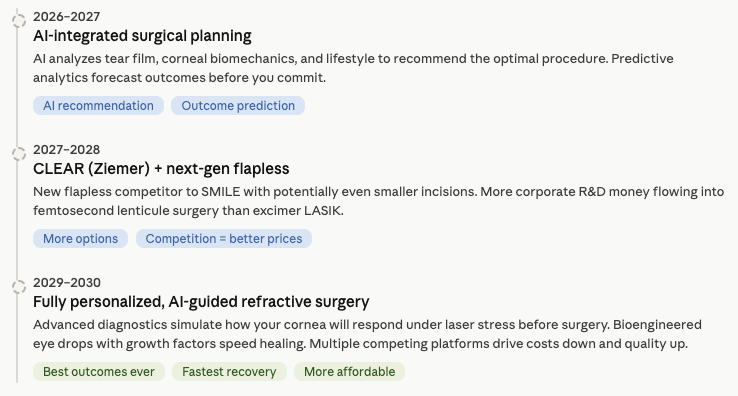
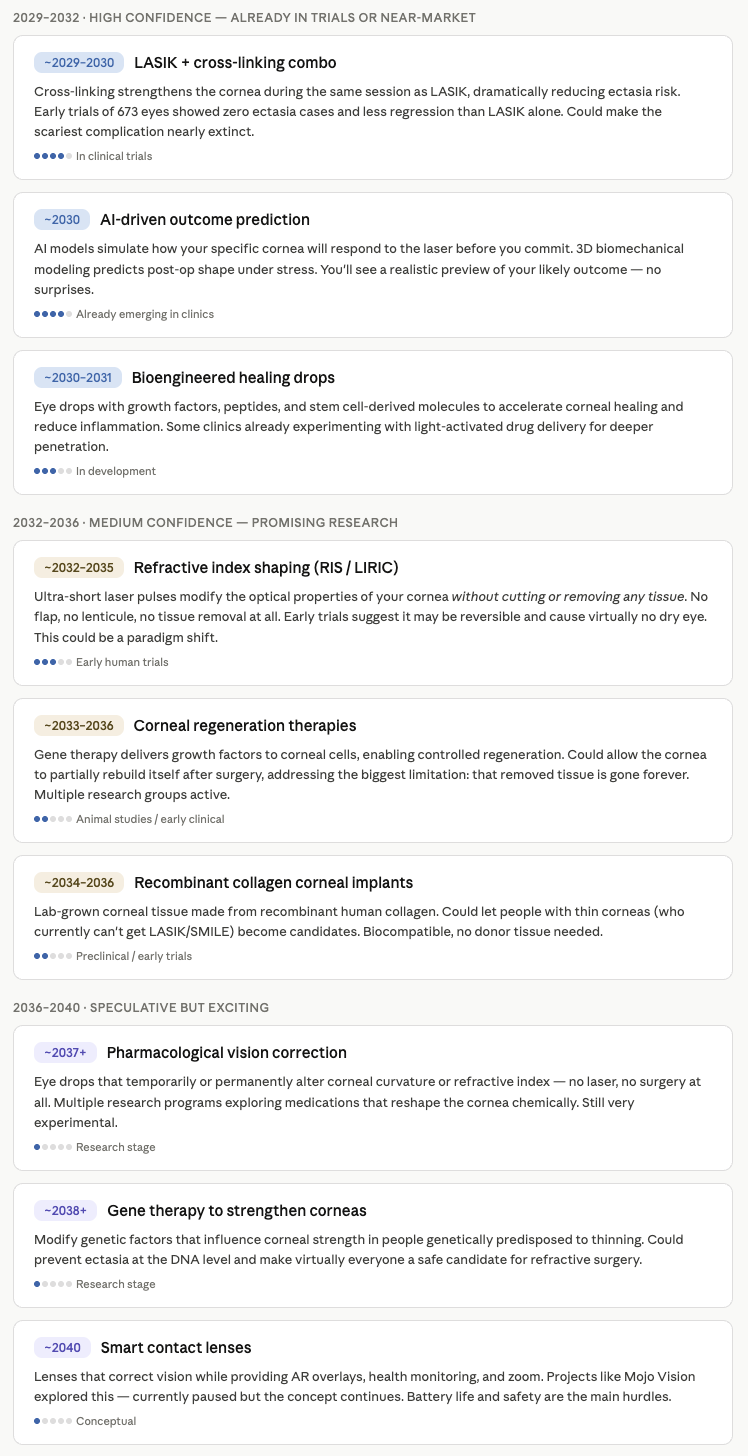
- Cross-linking combined with LASIK Strengthening the cornea in the same session as LASIK, meant to lower the risk of a rare corneal weakening complication. Whether it prevents it isn't proven yet.6 already in use / in trials
- Refractive index shaping A laser changes how the cornea bends light without cutting or removing any tissue.7 early human trials
-
Electromechanical reshaping
A small electric current briefly softens the cornea so it can be molded to shape, then it re-stiffens. No laser, no tissue removed, which I love the sound of.8
rabbit eyes in a lab only, per the 2025 report
The American Chemical Society's short video on the electromechanical reshaping work (Aug 2025). - Vision-improving eye drops Drops for reading vision, which usually starts to go around age 45, already exist (Vuity 2021, Qlosi 2023, Vizz 2025), but they work by shrinking your pupil for a few hours. They don't reshape anything and won't fix nearsightedness.9 first-gen approved; reshaping drops are far off
I don't know when any of these new techniques will arrive, but I am looking forward to it! For myself, I am choosing to wait because I believe the advancements are worth waiting for, and my vision is mild.
Appendix
A. How your eyes focus.
B. The timelines Claude made me.
Show screenshots
References
1 Timeline dates from the American Academy of Ophthalmology's "A Look at LASIK Past, Present and Future", Peyman's 1989 LASIK patent (US 4,840,175), and their SMILE explainer. Outcomes: Sandoval et al., "Modern laser in situ keratomileusis outcomes," Journal of Cataract & Refractive Surgery (2016): 99.5% at 20/40 or better uncorrected, 90.9% within ±0.5 D of target, about 1.2% dissatisfied. ↩
2 Schmack et al., "Cohesive tensile strength of human LASIK wounds," Journal of Refractive Surgery (2005), which measured central flap adhesion at roughly 2% of normal cornea and the flap edge at about 28%. See a case report of a flap dislocated 24 years later; these are rare and take trauma to the eye. ↩
3 Overview of LASIK flap and interface complications (epithelial ingrowth, diffuse lamellar keratitis): Moshirfar et al., 2014. ↩
4 Review of Optometry, "LASIK, LASEK or PRK for Cop?", on why officers who might face pepper spray have been steered toward flapless procedures. The one direct study I could find, a 2002 Journal of Refractive Surgery letter, reported that LASIK eyes held up fine after pepper spray exposure in military training. ↩
5 American Academy of Ophthalmology on SMILE, plus a peer-reviewed comparison of SMILE and LASIK: Titiyal et al., 2018. ↩
6 On LASIK Xtra: Review of Ophthalmology, "LASIK Xtra: Is It for Everyone?", and a review of cross-linking after refractive surgery: Corneal Collagen Crosslinking for Ectasia After Refractive Surgery (2024). Studies show good stability so far but have not directly shown it reduces the ectasia rate. ↩
7 Laser-induced refractive index change (LIRIC), from the University of Rochester and Clerio Vision: the Huxlin Lab overview and the first-in-human results (ARVO 2019). ↩
8 American Chemical Society, "An alternative to LASIK, without the lasers" (August 2025), and the earlier proof-of-concept in ACS Biomaterials Science & Engineering. ↩
9 FDA approvals: Vuity (Oct 2021), Qlosi (2023), Vizz (July 2025). For slowing kids' nearsightedness, low-dose atropine drops are used off-label; see the AAO's overview. ↩